
Building a Learning Through Play Team: Lessons From the LEGO Group
The LEGO Group put its characteristics in writing so decisions hold up when no one is there to guide them. What would that look like for your business? · Read the post →

Key Takeaways
- Write down what you stand for. Without a stated mission, vision, and values, the team is left guessing which version applies to their work today.
- Define your characteristics. A short list of how your organization works lets people make decisions when the founder is not in the room.
- Hire people who fit how you play. A learning through play environment only works when everyone on the team can play in the same way.
- Give people clarity and space. Light processes and clear roles set expectations, and room to solve problems keeps the joy in the craft.
My family and I had the opportunity this month to travel through Denmark, and I walked away with an appreciation for the childhood development and work philosophies of the Danish culture through the lens of the LEGO Group.
No visit to Denmark would be complete without visiting a Lego store. Even better is taking the journey west of Copenhagen to a small town called Billund, the home of Lego.
In Billund, you’ll find the Lego House museum. A celebration of creativity, childhood wonder, and worldwide corporate success. Everyone knows Lego and has some connection to the brand. The experience was a full day of complete joy where all ages came together to play. Each room of the museum had a theme: build a race car and compete, build a Lego fish to scan into the digital aquarium to watch your creation come to life, or build a spooky Halloween idea with all the special season-specific pieces. There were no wrong answers and little guidance. The museum did an amazing job of taking you through the history, poking at your nostalgia, and making every corner a spot for play.
Lego’s corporate philosophy is “Learning through play.” I can’t think of a more recognizable brand that lives and breathes that work. This experience also hit as I close in on one year of work under Valdivya. It’s been a year of regenerated creativity and an opportunity to redefine the rules for my work.
Creating a Learning Through Play Business Environment
In my career, I’ve found the best moments at work come when you are genuinely enjoying the tasks in front of you and the people around you. This doesn’t happen by accident. Lego was deliberate in their culture-building and product development strategy.
Write Down Your Mission, Vision, and Values
Lego shares their mission, vision, and values alongside their promises and spirit.
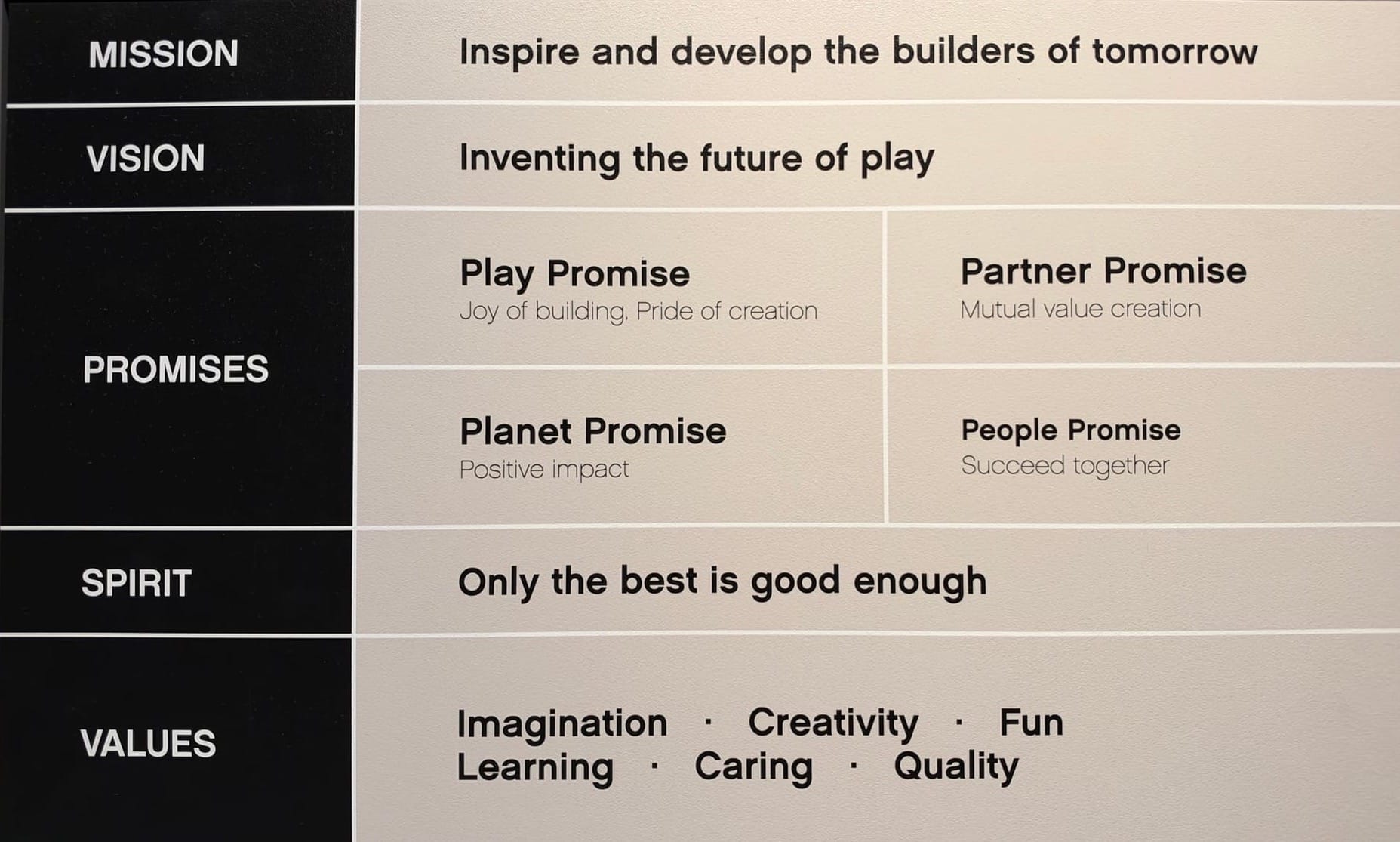
By writing it down and living it in every aspect of their brand, they’ve created the compass to make future decisions. The culture is built from having foundational pillars to stand on.
If you don’t have this for your organization, it’s still living somewhere and the team is guessing which version applies to their work today.
Define Your Characteristics
Lego has also shared their 10 Lego Characteristics. These characteristics were laid out by Godtfred Kirk Christiansen, the second-generation owner, to communicate the product development strategy to the organization, retailers, and customers.
The 10 Lego Characteristics
- Unlimited play possibilities
- For girls, for boys
- Enthusiasm at all ages
- Play all year round
- Stimulating and harmonious play
- Endless hours of play
- Imagination, creativity, development
- More Lego, greater play value
- Easy to supplement
- Sustained quality
These items each define how their product is developed and how it continues to develop over the years. You can hold up a Lego brick from 50 years ago and one from today and see how each holds up to these same standards. Each of the sets and their designs fits into this model. Everything clicks together to work across the decades of products and teams. As they develop new ideas, this direction helps their product teams make decisions that hold up across the organization. They’re not just for product teams. They define how an organization works. In a service business, sustained quality means a client who gets the same experience in year five that they got in month one. Easy to supplement means a new hire can step into a defined role without the team rebuilding how they work.
For a small business looking to gain traction, defining your characteristics will help shape the organization early. It will allow people to make decisions when the founder is not in the room and have them hold up against the company’s vision. Developing your characteristics can be a fun exercise with your team. What does it mean to work within your organization? Block off a couple of hours and develop these ideas. It will pay dividends as you expand the team. There is nothing revolutionary about the Lego characteristics. They do tell you what the LEGO Group stands for in their work culture, and yours should too.
Build the Right Team
These ideas will help define and codify your culture. To really shape it, leaders have to continue to build the framework of the organization through the people by making sure that everyone in the organization is the right person for their team and their role. You can’t create a learning through play environment if you have people who can’t play in the same way. It doesn’t mean they are bad people, just not right for your organization. They will be happier playing in another sandbox.
Give People Room to Play
To develop your play environment, people need to understand their role, their impact, and where they stand. By developing light processes and role definitions, team members can understand their expectations. Then it’s on the leaders to give people the space to do their jobs. I find that many people enjoy their work when they are given space to be creative in solving problems. As in the museum experience, there are countless ways to solve a problem and no singular right answer in business. Once they feel micromanaged with an older brother telling them what to do at every second, all joy in the craft is lost. People start going through the motions.
Craft the Boundaries
To develop a learning through play environment, you have to craft the boundaries for that environment. A shared vision, a mission, characteristics of your organization, and a group of people who understand their roles and the impact of their work will pay dividends in the happiness of your team and the output of the bottom line.
It’s not easy to develop the full operational strategy on your own, especially for founders who are new to scaling a team. It feels easy when it’s a few of you in a room. It’s a lot harder when you stop knowing everyone at a deeply personal level. It’s important to have some outside help to set a course and develop the operating system for your business. As I continue to build Valdivya, learning through play shapes how I help founders set a framework for team growth.